Thursday, June 20, 2013

Avoid Online Distractions

Based on the information here, I decided to add StayFocused to Chrome.  You tell StayFocused which websites you want to limit, and set a maximum time allowed on those websites.  Definitely helpful for limiting the time I spend on facebook & feedly.  One really nice feature: if you wish to extend your time, you get an irritating task to complete - for example, retyping a long paragraph character for character.  This puts up a sufficient barrier to prevent you from accessing content when you don't need to, but allows you to log in if when you really need to - for example, if you received an important message on facebook.
http://www.wikihow.com/Avoid-Distractions-Online#Tips

Tuesday, May 28, 2013

Dot Plots with pgfplots

I did some more tweaking and came up with this:

Much better, huh?  Here's the code... if you use it replace the "\\" with just "\"
\\begin{figure}
\\beginpgfgraphicnamed{dot_test}
% Preamble: \\pgfplotsset{width=7cm,compat=1.8}
\\begin{tikzpicture}
\\begin{axis}[
ymin=-.3,
ytick=\\empty,
x tick label style={major tick length=0pt}
] \\addplot+[only marks,mark=*] plot coordinates
{(0,3) (0,2) (0,1) (0,0) (1,0) (1,1) (1,2) (2,0) (2,1) (2,2) (2,3) (2,4) (3,0) (3,1) (3,2) (3,3) (4,0) (4,1) (4,2)};
\\end{axis}
\\end{tikzpicture}
\\endpgfgraphicnamed
\\end{figure}

Monday, May 27, 2013

Making Plots

As I mentioned before, I've been using Asymptote to generate geometrical figures, but I also would like to create nicely formatted plots - bot plots, dot plots, and histograms - with minimal effort.  I found a few options:

  • Asymptote does have a graphing library,  and it would be nice to not have to learn yet another tool.  However, I couldn't see how I could make it format things in the way I'd like.  For example, I'd like my histogram to have labels showing the range of values for each bin.  I think Asymptote is outstanding as a tool for general technical drawing, and it can certainly do graphing, but creating histograms, bar charts, and dot plots, I think that specialized tools (such as those below) will be more effective.
  • http://matplotlib.org/ - a python library
  • http://pgfplots.sourceforge.net/ 
    • creates histograms, box plots (shown in section 5.9.1 of the manual and in this question on tex.stackexchange).  
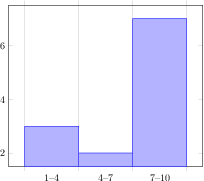
    • Getting dotplots in the format I'd like will take some doing... you basically use the scatterplot function to stack dots on top of each other.  Should probably move the x-axis labels further down, remove the y-axis labels, and obviously add a point at (2,2), but you get the general idea: 
    • It is possible to create a PDF that contains just the plot, using the directions in 7.1.2 of the manual: "Using the Externalization Framework of PGF 'By Hand'."  
  • R - 
    • Easy to export R graphs to PDF or PNG, though I was thrown off by the fact that some code that works to export to an PNG when executing line-by-line doesn't work when executing within a loop (see the ggplot2 section here)
    • When I tried to the image smaller, I ended up with a funny image where the fonts were disproportionately large.  I'm not sure how much effort would be necessary to fix this.  
    • The ggplot2 package does have a nice dotplot feature... with very little futzing I was able to produce this:
    • I want to write a loop that will create a whole bunch of random plots and write the related information (mean, median, range) to the database.  It took me a while to figure out how to configure the ODBC database connection to MySQL - you have to make sure that everything is either 32-bit or 64-bit, otherwise R throws the error: [RODBC] ERROR: state IM014, code 0, message [Microsoft][ODBC Driver Manager] The specified DSN contains an architecture mismatch between the Driver and Application.
Decision: In the end I think pgfplots is the quickest way to produce nicely formatted images of the desired size.

Thursday, May 23, 2013

Bogus Criticism of the Common Core

Here's a popular post at The Atlantic, criticizing the Common Core math standards.  The author approvingly quotes an email from a math teacher:
I am teaching the traditional algorithm this year to my third graders, but was told next year with Common Core I will not be allowed to. They should use mental math, and other strategies, to add. Crazy! I am so outraged that I have decided my child is NOT going to public schools until Common Core falls flat.
They can't use the standard algorithm, but instead must resort to "mental math" and "other strategies"?  Hmmmm... let's take a look at the standards for third grade, available at www.corestandards.org:
CCSS.Math.Content.3.NBT.A.2 Fluently add and subtract within 1000 using strategies and algorithms based on place value, properties of operations, and/or the relationship between addition and subtraction.
Please notice that this does not forbid the "standard algorithm" for addition.  Rather, as I read it, this means that the standard algorithm can be taught, but it must be taught with reference to place value, properties of operations, and/or the relationship between addition and subtraction.  When we, for example, do \(17+24\) we recognize that that 17 is composed of one ten and seven ones, while 24 is composed of two tens and four ones.  We can add numbers in whatever order we like without changing the result, but if we are doing the standard algorithm we begin by adding the four and the seven, \(4+7\), which gives us 11, or one ten and one one.  We then add the tens (one from 17, the two tens from 24, and the ten from 11) to get \(10 + 20 + 10\) to get 40.  Our final result is 41.  This can be shown in the standard algorithm using the standard way of writing things it (with one number on top of the other, lining up the tens and the ones), but we don't use terms like "carry" and  we make sure to remind students that the first 1 in eleven is not "1" but rather "1 ten."

So, I don't think the teachers complaint is even slightly legitimate.  However, I do think it points to a real question - will the common core be implemented correctly?  Will teachers get the misimpression that they must stop teaching the standard algorithm?  As far as I can tell, the mathematics core standards are far better than the prior standards, but will the standards be used in a way that will improve the quality of math education?

Wednesday, May 22, 2013

6th Grade Common Core Math Worksheets:


These are the ones I've put together so far:

  • Ratios & Proportional Relationships
    • A.1 Describe a ratio relationship between two quantities
    • A.2 Use rate language in describing ratio relationships
    • A.3 Solve problems using ratio and rate reasoning
  • The Number System
    • B.2 Divide multi-digit numbers
    • B.3 Add, subtract, multiply, and divide multi-digit decimals.
    • B.4 Find the gcf and lcm. Use gcf to factor the sum of two integers.
  • Expressions & Equations
    • A.1 Expressions with whole-number exponents.
    • A.2 Write, read, and evaluate expressions in which letters stand for numbers.
    • A.3 Apply the properties of operations to generate equivalent expressions.
    • A.4 Identify when two expressions are equivalent.
    • B.5 Determine whether a given number makes an equation or inequality true.
    • B.6 Write expressions using unknown variables to solve real world problems
  • Geometry
    • A.1 Find the area of regular polygons
    • A.2 Find the volume of rectangular prisms.
The most current version can be found here: http://www.mathtestnow.com/problem_index.php

Making my site crawlable

My site does terribly when I google it.  I realized there are a few major problems:
  • I haven't done the extra work necessary to get Google to index AJAX content
  • Most of the site's content is behind the login, so the bots can't find it.
  • Using JavaScript redirects rather than <a href="URL">link</a>
  • Solution:
    • Make sure that all the pages I want indexed can be reached via a simple href link that does NOT require login.  
      • As they explain here  buttons using javascript can be changed so that they are really links which are simply styled as buttons.
    • Create a large repository of static content that does not require a login.  Direct traffic to this.

Tuesday, May 21, 2013

Updates to MathTestNow

I haven't been doing regular updates on my progress with MathTestNow.com, but things are moving along:

  • Posted sample worksheets to TeachersPayTeachers.  I plan to make some free and some $1.
  • Got some really wonderful help from a guy at StackOverflow about how to make AngularJS and MathJax play nicely together.
  • Had a friend who is a math teacher take a look at the website - made me realize that I had a number of issues with the user interface on the main page.
  • Creating more question types and improving existing ones.
  • Creating sample worksheets for each content area.
  • Redoing some of the image files that were too large
  • Having trouble formatting the PDFs when there are images.  Asked a question at http://tex.stackexchange.com